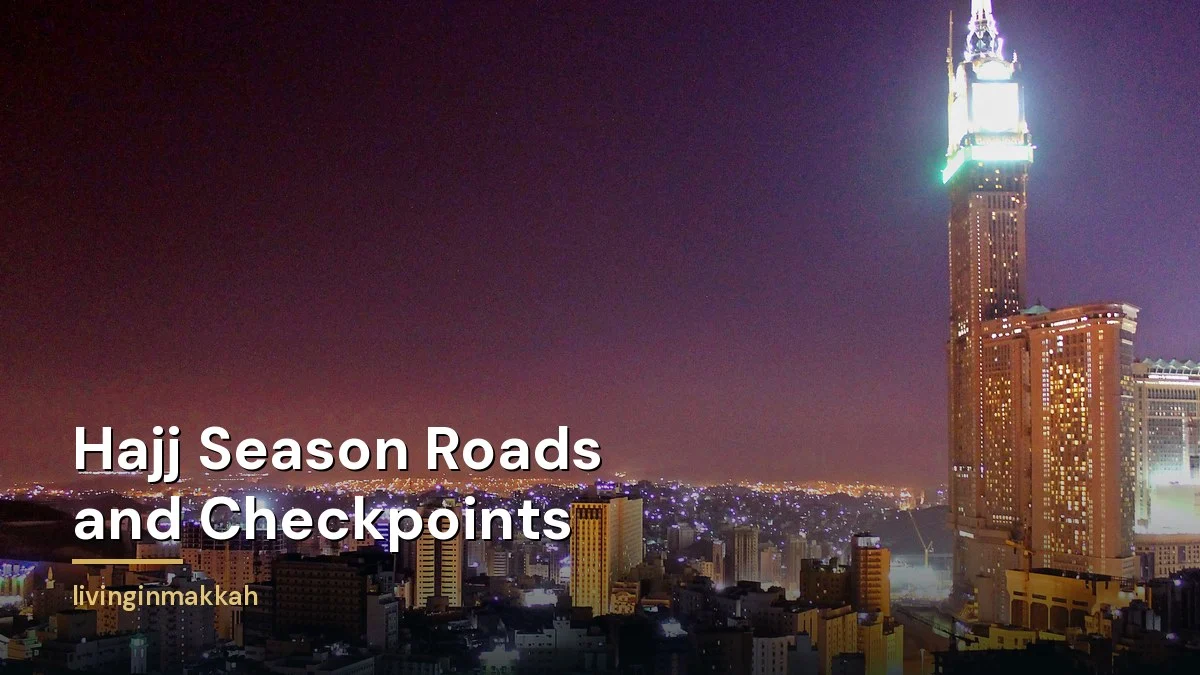
By Dr. Malik Sherjeel Awan, PsyD · Last checked 17 November 2026 · Rules change every season, so check official notices before you travel
Published by Dr. Malik Sherjeel Awan, Makkah
Each spring, the roads into and around Makkah change. Checkpoints appear on the main entry routes, some streets near the Haram and the holy sites close or switch direction, and journeys that take 20 minutes in winter can take much longer. None of this is a surprise if you plan for it.
This guide explains how the system worked in 1447 (2026), the latest season with published rules, and how to plan your own trips for Hajj 1448. Hajj 1448 is expected around 14–19 May 2027, with the Day of Arafah around 15 May, subject to moon sighting. The 1448 traffic and entry arrangements haven’t been announced yet, so treat everything below as a guide to the pattern, not a promise of the dates.
Why the roads change
Makkah hosts more than a million pilgrims in a few days. The authorities manage that with permits, checkpoints and staged transport plans. Pilgrim buses follow set routes, for example, and the Pilgrim Bus Guidance Center publishes an operational plan each season. Ordinary traffic has to fit around that. The Ministry of Hajj and Umrah describes the permit system as a key part of crowd management. Seeing it that way makes the checkpoints easier to accept.
The 1447 pattern in three stages
- From 25 Shawwal 1447 (13 April 2026): residents entering Makkah needed an official entry permit, unless they held a Makkah-issued Iqama, a Hajj permit or a holy-sites work permit. Those without one were denied entry.
- From 1 Dhu al-Qa’dah 1447 (18 April 2026): only Hajj-visa holders, among visitors from abroad, could be in Makkah. Visit-visa holders of every type could not enter or stay.
- Around the Hajj days: the Ministry of Hajj and Umrah said performing Hajj in 1447 was restricted to those with an official permit, so the holy sites of Mina, Muzdalifah and Arafat were for permit holders, and traffic arrangements were tightest around them and the central area.
If 1448 follows a similar shape, the first stage would begin around 2 April 2027 (25 Shawwal 1448) and the second around 8 April 2027 (1 Dhu al-Qa’dah). These are calendar conversions, not announced dates.
What happens at a checkpoint
The Ministry of Interior’s 1447 announcement said residents entering Makkah needed a permit unless exempt, and the official guidance describes permit checks at security points at the entrances to the city, the holy sites and the roads leading to them. In practice, expect to be asked for:
- your Iqama or ID, and those of your passengers
- the entry permit or exemption that applies to each person
- for workers, the holy-sites work permit issued through Absher Individuals or the Muqeem portal
The 1447 official guidance said that transporting people who don’t hold Hajj permits is a violation punishable by law, and that courts can be asked to confiscate vehicles used to carry visit-visa holders into Makkah or the holy sites during the restricted period. Never offer a lift to someone whose permit you haven’t seen.
Where to find official notices
Road arrangements change from year to year and sometimes within the season. Rely on official sources rather than last year’s screenshots or forwarded voice notes:
- Ministry of Interior and Public Security announcements, reproduced in English on the Pilgrim Experience Program site (pep.gov.sa)
- the Saudi Press Agency (spa.gov.sa) for official statements
- Absher, for your own permits and any traffic notices tied to your account
- the official Makkah Bus app, for route changes during Ramadan and Hajj
- your employer’s HR, if you work in the city
If something on social media sounds alarming or too convenient, look for the same notice on an official site before you act on it.
Planning your own trips
Map your fixed journeys
List the trips you can’t skip: work, school runs (if school is still on), hospital appointments and airport runs. For each one, ask:
- Does it cross an entry checkpoint?
- Does it pass near the Haram or the road towards Mina?
- Can it be done earlier, later or by a different route?
Leave earlier than you think
Queues at checkpoints and on the main roads can be long in busy periods. Build in extra time, especially on the routes into the city.
Keep documents ready
Have every passenger’s Iqama and permit ready before you reach the officer, printed or saved offline on your phone. Mobile signal can be weak in crowded areas.
Consider leaving the car
Inside the city, the bus network or a licensed taxi can be easier than driving and parking near the centre. Our Makkah buses guide explains the official app. Routes change in the busy seasons, so check on the day.
Stock up before the busiest week
Many residents do the big shop, fill prescriptions and finish car servicing before the Hajj week, so they don’t have to cross the busiest roads.
Airport runs and Jeddah trips
If you live in Makkah and need to collect someone from Jeddah, the return trip is the one to check. Everyone in the car needs to qualify to enter Makkah during the restricted period. A relative arriving on a visit visa would not, under the 1447 rules. See Makkah to Jeddah airport for normal-season options.
If you’re turned back
Stay calm and polite, and follow the officer’s instructions. Don’t argue or look for another way round the checkpoint. Check what was missing, fix it through Absher, Muqeem or your employer, and try again once it’s in place. Trying to get round the system can bring fines or worse, and it puts the crowd management everyone relies on at risk.
A word on patience
Hajj-season traffic tests everyone’s patience, especially in the heat with children in the back. It helps to remember why it’s happening: the city is hosting guests who may have saved for this journey all their lives. The Qur’an reminds us that “Allah does not charge a soul except [with that within] its capacity” (Qur’an 2:286). Plan for what you can control and leave buffer time for the rest.
FAQ
Are the checkpoints only for pilgrims?
No. In 1447 the permit rules applied to residents entering Makkah as well as to visitors, unless an exemption applied.
My Iqama was issued in Makkah. Do I still get stopped?
You may still be checked. In 1447 a Makkah-issued Iqama was an exemption from the entry permit, so carry it every time.
Which roads will close in 1448?
That hasn’t been announced. Closures depend on each season’s plan, so check official notices nearer the time.
Can I drive to Mina or Arafat to drop off a relative?
Only if you and your vehicle are permitted for the holy sites. In 1447 these areas were limited to permit holders.
Who do I call in an emergency on the road?
Call 911, the emergency number for the Makkah region.
Related reading
- Getting around Makkah
- How to check traffic fines (infosaudia.com)
- Choosing a licensed, official Hajj option (madinamakkah.com)
General information only, based on the latest published (1447) rules. It isn’t legal advice. Always follow the instructions of officers on the road and the official 1448 announcements.
Sources
- Ministry of Interior, Hajj 1447 arrangements (entry permits from 25 Shawwal; exemptions; only Hajj-visa holders in Makkah from 1 Dhu al-Qa’dah) via DARP: https://pep.gov.sa/en/news/926
- Public Security, Makkah entry permit requirement (via DARP): https://pep.gov.sa/en/news/925
- UAE MOFA, Instructions and guidelines for Hajj 1447 (vehicle rule: no transporting people without permits into Makkah and the holy sites; impoundment): https://www.mofa.gov.ae/-/media/Feature/News/files/instructions-and-guidelines-for-hajj-1447ah-EN.pdf
- Saudi Press Agency, 1447 penalties and reporting numbers 911 / 999: https://spa.gov.sa/N2564644
- Ministry of Hajj and Umrah, permit system as a critical component of crowd management (via DARP): https://pep.gov.sa/en/news/930
- Pilgrim Bus Guidance Center 1447 plan (via DARP): https://pep.gov.sa/en/news/928
- Royal Commission for Makkah City and Holy Sites, Makkah Bus: https://www.rcmc.gov.sa/makkah-transport/makkah_bus
- Expected 1448 dates: Umm al-Qura calendar (1 Dhu al-Hijjah 1448 = 7 May 2027; 9 Dhu al-Hijjah = 15 May 2027)
- Qur’an 2:286 (Sahih International, quran.com)
Featured image: "Mecca at night" by عباد ديرانية, via Wikimedia Commons, CC BY-SA 3.0; cropped, with title added.