By Dr. Malik Sherjeel Awan, PsyD · Last checked 20 November 2026
Published by Dr. Malik Sherjeel Awan, Makkah
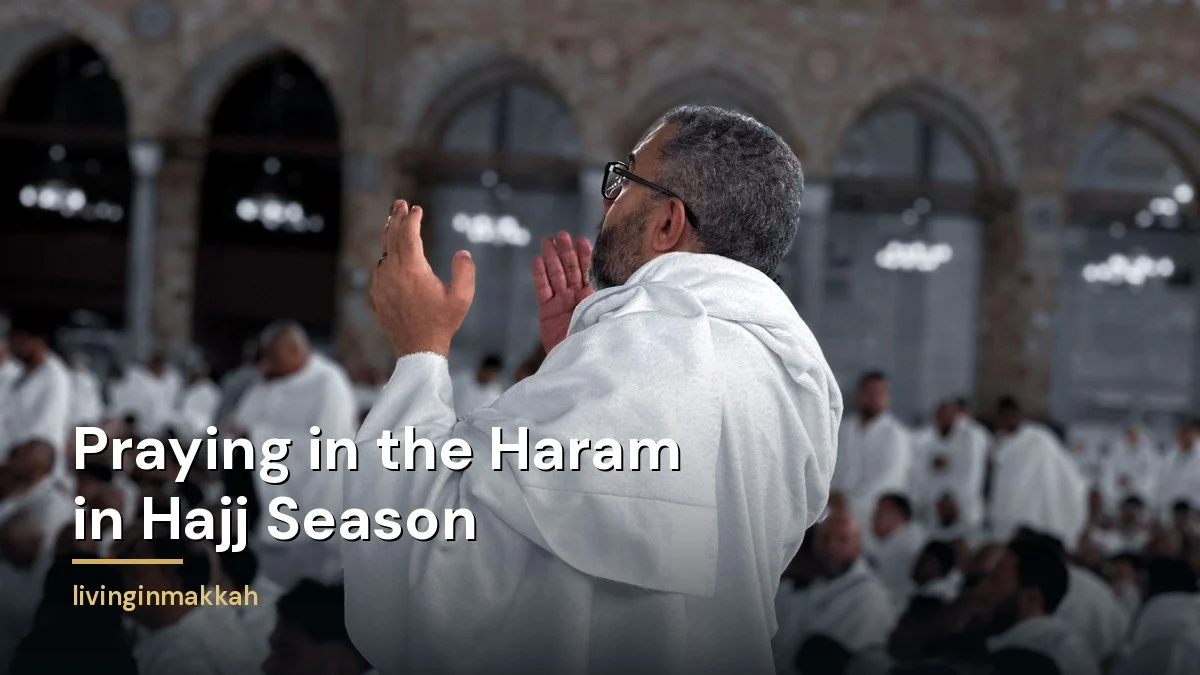
One of the great gifts of living in Makkah is praying in Al-Masjid Al-Haram whenever you can. During Hajj season that gets harder. The mosque fills with pilgrims, the roads around it change, and a trip that is easy in winter can take hours.
This guide helps residents plan daily and Friday prayers in the Hajj season: when the crowds peak, which official tools help, and when your local masjid is the better choice. Hajj 1448 is expected around 14–19 May 2027, subject to moon sighting. The 1448 arrangements haven’t been announced yet, so the details below draw on the 1447 season.
Why the Haram is so full in Hajj season
The Qur’an describes the Kaaba as “a place of return for the people and [a place of] security” (Qur’an 2:125). In Hajj season, that return happens on a vast scale. The Prophet ﷺ named Al-Masjid Al-Haram first among the three mosques worth setting out on a journey for (Sahih al-Bukhari 1189). Pilgrims have come a long way for this, often once in a lifetime.
The crowd follows the Hajj rites, so you can roughly predict it:
| Period (expected 1448 dates) | What pilgrims are doing | What residents can expect |
|---|---|---|
| Late Dhu al-Qa’dah to 7 Dhu al-Hijjah (about late April to 13 May 2027) | Pilgrims arrive and many perform Umrah | Crowds build daily; Fridays are especially full |
| 8–9 Dhu al-Hijjah (14–15 May) | Pilgrims move to Mina and Arafat | The Haram can feel quieter, but roads to the holy sites are very busy |
| 10–13 Dhu al-Hijjah (16–19 May) | Tawaf al-Ifadah and the days in Mina | Some of the heaviest crowds of the year in and around the Haram |
| After 13 Dhu al-Hijjah | The farewell Tawaf as pilgrims depart | Crowds stay high for days, then ease slowly |
These are patterns, not schedules. Travel plans, heat and official arrangements all shift them.
Do residents need a permit to pray?
Praying in the Haram is different from performing Umrah:
- Umrah needs a Nusuk permit. In 1447, Umrah permits for citizens, GCC nationals, residents and other visa holders were suspended from 18 April to 31 May 2026. Expect something similar in 1448 and plan your own Umrah outside that window.
- Entering Makkah needed a permit in 1447 unless you held a Makkah-issued Iqama, a Hajj permit or a holy-sites work permit. If you live outside the city, this matters before you even reach the Haram.
- Inside the mosque, some areas, routes and entrances may be reserved or redirected at peak times. Follow staff and signs on the day. These arrangements change, so we don’t list them here.
Planning daily prayers
Pick your prayers
Many residents choose one or two prayers a day at the Haram in the busiest weeks rather than all five. Some times of day may be easier than others, but it changes from day to day, so check how it looks before you go.
Use the official crowd tool
The Two Holy Mosques Authority offers a crowd density viewing service for the Mataf and the Masaa. It shows congestion with simple colour indicators, so you can pick better times and routes. Check it before you leave home.
Arrive early and stay put
At peak times, arriving well before the adhan and staying in one place until after the prayer is easier than moving through crowds. Know which area you’re heading for before you set off.
Travel light
Bring water, your ID and your phone, and little else. See the madinamakkah.com guide on what to carry into the Haram.
Friday prayer in Hajj season
Jumu’ah during the pilgrim weeks is the most crowded time for many residents. If you plan to attend:
- leave much earlier than usual, because roads and the nearest prayer areas fill quickly
- expect to pray outside, in the courtyards or surrounding streets, in the heat
- agree a meeting point with family in case you get separated
- check road and bus arrangements first, using our guide to Hajj-season road closures and checkpoints
Our Friday in Makkah guide covers the normal-season routine.
When your local masjid is the better choice
For many families, the wiser choice in the busiest days is the local masjid, especially for:
- elderly relatives or anyone with heart, lung or kidney conditions, who are more vulnerable to heat (WHO)
- young children, who struggle with long waits in the heat
- anyone who is unwell, pregnant or recovering from illness
Choosing your neighbourhood masjid for a few weeks isn’t a loss. It also leaves space for guests who may never return. “Allah does not charge a soul except [with that within] its capacity” (Qur’an 2:286).
If an elderly relative wants to go, consider a quieter prayer time and use the official mobility services. See wheelchairs and electric carts at Masjid al-Haram.
Heat and health
May afternoons in Makkah are hot. WHO advises avoiding strenuous activity in the hottest part of the day, staying in the shade and drinking water regularly. Long waits outdoors before Jumu’ah add up. If anyone feels faint, confused or very unwell in the heat, get help from the nearest medical point or call 911.
Being a good neighbour to pilgrims
Residents often know the mosque better than any visitor. Small kindnesses help a lot: making space in a row, pointing someone to a gate or a water point, or simply being patient in a crowd. Avoid saving large spaces, pushing forward, or blocking walkways.
FAQ
Can I do Umrah during Hajj season as a resident?
In 1447, Umrah permits for residents were suspended from 18 April to 31 May 2026. Plan your Umrah before or after that window, and check the 1448 rules.
Is the Haram closed to residents during Hajj?
We found no general closure for prayer in the 1447 announcements we checked. Some areas and routes can be reserved or redirected at peak times, so follow staff instructions.
What’s the quietest time to go?
It changes daily. Check the official crowd density service before you leave, and allow extra time before Friday prayer.
Can I take my children?
You can, but in the busiest weeks think carefully about heat, long waits and the risk of getting separated. A local masjid is often kinder for young children.
Related reading
- Hajj season 2027 in Makkah: residents’ guide
- Prayer times and crowds at the Two Holy Mosques (madinamakkah.com)
- Friday in Makkah: a practical guide
General information only. Access arrangements inside Al-Masjid Al-Haram are set by the Two Holy Mosques Authority each season, so follow its announcements and the staff on site.
Sources
- Two Holy Mosques Authority, crowd density viewing service for the Mataf and Masaa (via DARP, 21 Apr 2026): https://pep.gov.sa/en/news/937
- Ministry of Interior, Hajj 1447 arrangements (Umrah permits suspended for residents and others 18 Apr to 31 May 2026; entry permits) via DARP: https://pep.gov.sa/en/news/926
- Nusuk card required for pilgrims’ entry to Makkah, the holy sites and the Prophet’s Mosque (via DARP): https://pep.gov.sa/en/news/952
- Expected 1448 dates: Umm al-Qura calendar (8 Dhu al-Hijjah = 14 May 2027; Eid = 16 May 2027; 13 Dhu al-Hijjah = 19 May 2027)
- Sahih al-Bukhari 1189 (sunnah.com/bukhari:1189)
- Qur’an 2:125, 2:286 (Sahih International, quran.com)
- WHO, heat and health fact sheet: https://www.who.int/news-room/fact-sheets/detail/climate-change-heat-and-health